Sunday, September 11, 2016

almond joy


when I was a kid, I used to love Almond Joy candy bars. coconut with an almond on top.  all covered in chocolate.  wow. 

truth be known I still will get an Almond Joy from time to time. 

one of my favorite expressions over the years has been "um boy...almond joy!"

let me tell you, we had an experience last evening that was as far away from an almond joy as you can get.  we had a three hour lesson in Italian cooking in Tuscany, Italy.

to set the stage properly, let me remind the readers of this blog about the sculpting class we had in Florence just a few days ago.  you will recall that I admitted that none of the three of us had any experience whatsoever in sculpting. 

I need to repeat that same admission here.  none of the three of us are cooks. 

wait a second, that may be a little harsh.  PJ and I use the microwave quite a bit. I do some grilling from time to time.  Tom has been known to rustle up a PB&J occasionally.  but, the bottom line is that we are not cooks.

having said that, we are ready, willing and eager.

our first task was to find someone who had the guts to try to teach us how to cook.  we luckily found Marta.  what a sweetheart.  always a smile on her face.  she was so accepting of us and our capabilities. a real workhorse. nothing was too much of a trouble.  a bundle of energy.  very efficient.  knows how to slice a tomato.  can peel a garlic clove in a second.  we were, needless to say, in awe.  more accurately, our mouths were wide open most of the time.


I should step back.  our very first task was to be dressed properly for the job of cook.  so, we adorned aprons and tied them in the back.  we learned that is not as easy as it looks.

then we placed white hair nets on our heads, capturing to the extent we could all of our hair.  at this point we began to realize that we would not be on the cover of GQ magazine.

the cooking class took place in her restaurant, La Cisterna nel Borgo located in Rocca d'Orcia, a very small community tucked away in the Tuscan hill country.  not easy to find, and in accessible by automobile.  from where you park your car, you have a good 10-15 minute walk to the restaurant.


she has room for 60 persons a night.  dinner only.  one seating only.  open six nights a week in her 8 month season. she takes off 4 months each year in the slow season.

within her restaurant, the class took place in the very small kitchen.  because of the historical preservation rules she has to operate within the boundaries of the building which was built centuries ago.  no expansion of the walls is possible.  it was a tight space for the three of us, plus Marta.

she taught us how to make a cheese salad (not shown), a pasta and tomato sauce, a main dish of red pepper stuffed with tuna, and a ricotta desert. for those of you who like the recipes, let me know I will be happy to forward them to you.


we learned the recipes for each. we learned how to slice and dice.  we learned how to peel a garlic clove, how to separate the parsley leaf from its stem, how to slice and dice a tomato, how to prepare a red pepper for cooking, how and why to use two day old bread, how to roll out and how to roll up your pasta, how to cut your pasta, why the bread crumbs that we cut up had to be the same size, why to mix the capers only so much and not too much, what a difference a little bit of dried red pepper flakes can make, and more.


but what was most telling to each of us was the emphasis she placed on the source of her ingredients.  she said it made all the difference.  where and when she got her tomatoes. the kind of tuna she sourced. the type of flour she used. 


Needless to say we learned a lot.

Maybe PJ and Tom don't know how to eat the Italian way (see previous blog), but they are learning how to cook the Italian way

Saturday, September 10, 2016

a day in the Tuscan sun

we have been in Tuscany for the last three days and we have another one and a half days to go.

I think that we have finally figured out what it is about Tuscany that is so enthralling, so inviting, so delightful.

what we did today was almost nothing, and I think that may be the key to really getting the most out of Tuscany.

when I say we did almost nothing, what I mean by that is that we stayed close to home.  home being our agriturismo just 4 kilometers outside of Pienza, a small community of 2,000 people in the heart of Tuscany.

our agriturismo is essentially a farm house that has been converted into 6 or so small apartments.  we have a small pool, which is not heated.  we have a hammock.  we are surrounded by kilometers of fields, of agriculture.  the only exception to this is the long gravely driveway into the farmhouse from the main road.  we have a breakfast room where all the residents like us gather in the morning.  each apartment has an outside patio with a table and chair or two. 

the single greatest thing about where we are staying is the lack of noise.  the lack of the cacophony of city sounds.  no air conditioners.  no emergency vehicles.  no street banter.  no late night carousing.  this is in the rolling farm country of the province of Tuscany. 

what hits you first is the clean air.  your first instinct is to take a deep breadth.  and, then, you also become aware of the aroma of manure. yes, this is farm land.

when you are here you feel relaxed.  you want to curl up and read a book.  you want to take a nap. you want to contemplate. 

so, today, after having our breakfast we decided to take it real easy, as opposed to our other days when we have been going from site to site, or experience to experience. 

what does "real easy" mean?  well, after breakfast we returned to our apartment for a "rest" for the next two hours.  for some of us, this turned into a morning nap.  for others of us, it meant lying in bed reading a wonderful novel about Positano, our next stop in Italy.

then, around 11am PJ and I got in the car for a day trip to Pienza, the nearest town to us.  (Tom unfortunately is on his back today, having something not agree with him.  see upcoming blog)

both of us have been to Pienza before, having had dinner there two nights ago.  but, on the previous visit we had just strolled through the town, and had not followed the Rick Steve's self guided walking tour.  today was our day to do the town the right way.

we knew, however, from our previous time there that we really liked the community. its scale, its feel, its ambiance.  Pienza does not have the hordes of tourists that many of the other classic Tuscany hill towns experience.

finding parking is always a challenge in the Tuscan communities, and it was for us today.  but we managed.  we meandered through the town, reading out loud about the sites with the anecdotes and the history as outlined by Rick Steves. 

what sets Pienza apart from other communities is that this was the home of Pope Pius II.  therefore the name of the town.  he reshaped the community to reflect his vision of the world at that time (the middle of the 15th century). thanks to him, it is very much a Renaissance town, with great architecture, gorgeous vistas, the use of natural light in almost a lyrical way, and the main square (piazza) that is to die for -- maybe the most symmetrically designed one in Italy. 


and, most importantly, not many tourists.  AND, most of what tourists there are, are Italians.  what a relief from the crowds of non Italians in Florence, Venice and Cinque Terre.

the other thing that makes Pienza so great is that there are no cars in the old city part of town. just people walking and going about their daily business.

after our stroll through the beautiful alleys and byways of the old city, we stopped for lunch.  this lunch was a little unusual for us in that it was a sit down in a very beautiful, first class restaurant.  this was not what we have done most days -- namely, stopping in shops to pick up some bread, then going to other shops to pick up some cheese and salami.  and then finding a bench to sit on to eat our lunch.  no, this was real sit down affair.


in other words, we took time to relax and reflect and enjoy and savor our mid day meal.  we were not grabbing our bread and cheese on the run, as we have been doing most other days.

this lead to a delightful conversation with the table next to ours.  we met a couple from Staten Island in New York City and their friend, of Italian ancestry, who grew up in New York, but now is a minister in Winnipeg Canada.  all three are true New Yorkers. 

we had more fun talking with them. 

after lunch, our first priority, as you know by now from reading my blog, is to find a gelatoria.  we found one, with the assistance of Rick Steve's guidebook. 

let me tell you, we have had a lot of gelatos in the last 10 days in Italy, but nothing -- nothing -- compares to the gelato that we just consumed.  it was out of this world.  wow!!

as if that was not enough, we then come outside to lick and gradually consume our cones of gelato, when we meet a woman sitting on the bench in front of the gelatoria who is consuming her gelato.  we start up a conversation that lasts for the greater part of an hour. 

Carol is an Irish girl, in her mid to late 40's, who has lived in Italy for the last five years.  she is alive and engaging and a stitch.  we have a ball conversing on a wide variety of topics. she is also enjoying the repartee. 

she had PJ wrapped around her finger very quickly.  to give you an example, she asked what our ancestry was.  PJ, so enthralled with the conversation, and knowing that she was 100% Irish, tells her that he is 100% Irish.  the implication of course being that he and she are soul mates.


I, being the rookie in the conversation, am stupid enough to take the question seriously and answer honestly. I told her that I am 12.5% Irish.  in other words, I am worth something, but not very much.


long story, short.  we had a delightful conversation with her.  she was so insightful about what it was like living in Italy. 

after we said goodbye to Carol, we returned by car to our farm house for our afternoon nap.

awaking from our naps we head to Pienza again for a delicious meal at a hole in the wall restaurant with only seven tables.  after dinner we are the last people to get a gelato from our favorite gelatoria (see above).  then we amble over to the town square to join 400 local residents enjoying an outdoor performance of something.  we have no idea what it was.  we recognized that it was a parody on Zeus, with Mercury and others heavily involved.  it was all in Italian, but it was great fun.  the cast was made up of some professional actors but the majority of the cast were local amateur thespians.


not a bad day. 

to summarize, today we ate, slept, strolled, ate, conversed, slept, ate, took in a play, slept....   you get the idea.

what a wonderful day under the Tuscan sun. 


Thursday, September 8, 2016

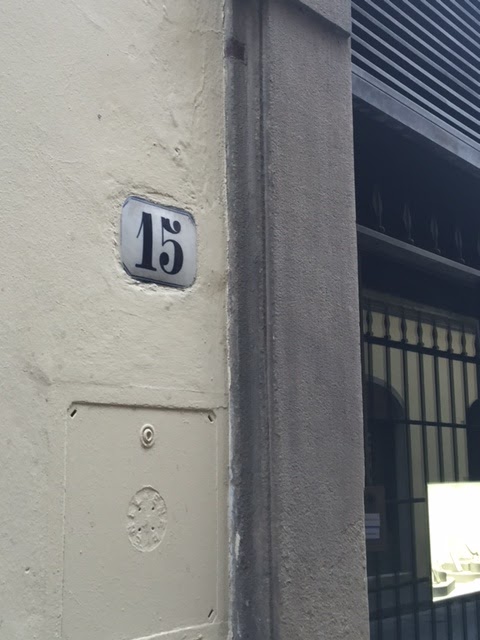
the numbering system on Florence's streets

here is one for you.  I love Florence, but...

Florence, and two other cities in Italy, has an unusual system for numbering their homes, businesses and buildings along their streets.

their system is contrary to what most cities do. most cities have a system where each block starts a new set of sequential numbers usually beginning with the next 100.  so, for example, the first house or building on a block would be 100, and then the next one will be 102.  usually the even numbers are on one side of the street, and the odd numbers on the other side.

this continues until the next block when the process starts over again, but with 200.  the next building would be 202.  you get the idea.

well, in Florence, they do it differently.

first of all they distinguish between residential and commercial buildings.  the residential get black numbering, and the commercial ones get red numbering.


then they give the same numbers out for different buildings on the same street, depending whether they are residential or commercial.  so, a typical street would work like this.

the first building would be 100, and the second building would be 102, and the third building would be 104, and so on, assuming that they are all of one class -- either all residential or all commercial.  if by chance, there are different types of buildings on the same block it can get very confusing.

for example, the first building is a residential building and is numbered 100. the second building is also residential and is numbered 102. if the third building is deemed to be a commercial building it will be numbered 100, but the number will be in red paint, not black paint.

let's say the fourth and fifth buildings are residential and number 104 and 106 and the numbers are displayed in black.  if the next building is a commercial building, its number will be 102.  yes, 102, albeit in red.

if this is not confusing enough, take this in.  over the years the red on the commercial building numbers has faded and today look like a dull grey, close to black.

if that is not enough, then catch this.  what do you think is the definition of "commercial"?  over the years and with different government bureaucracies the definition has changed.  so on one street you can have a hotel be considered "commercial" and then further down the same street another hotel could be considered "residential". 

the result is total chaos, unless you live there and know who lives and works where.  then it all works. 

there are so many things to love about Florence, and in this case, you have to love that it is a relatively small city so most people who live and work there know the city like the back of their hand. 

if you are a visitor to Florence, this numbering system will provide you with some anxious and confusing moments.

what would life be like if we did not have new challenges to face each day?
 

PJ's and Tom's efforts to adopt to Italian culture, customs and mores


PJ and Tom are real troopers.  yes, indeed.

neither one has ever been to Italy before.  in fact, PJ has never been to Europe before.

they came with an open mind. they wanted to learn about and enjoy the Italian culture and mores.

and they have done so.  for example, they have become more demonstrable in their conversations.  they are using their hands and arms more to make a point.  they have, after nine days in Italy, begun calling the currency Euros and not dollars.  they have learned to accept the fact that elevators do not exist in many buildings and that walking up several flights of stairs is commonplace.  they have learned how to order gelato with some Italian flourish. 

having praised them for what they have observed, learned and adjusted to,  I must relate that there is one part of Italian customs and tradition that PJ and Tom are having great difficulty adjusting  to.  that area is dining. 

this is very unfortunate because eating is a huge part of the Italian culture.  it is really important.  Italians value their food very much.  they honor the culinary experience.  they take the time to really enjoy and absorb the eating experience.  it is considered an art form.  it is viewed as more than nourishment. it is viewed as life.

the traditional main meal for Italians is made up of eight courses.  the first one is the aperitivo or appetizer course.  the second is the antipasto or starter course.  the third is the primo course, which is often pasta. the next course is usually the meat or fish dish.  that is followed by the contorno course which is usually vegetable based. followed by the insalata or salad course.  then the formaggi and frutta course -- cheeses and fruit. then finally, that is followed by the dolce or desert course.  eight courses, served sequentially.  some examples follow.


in addition, the Italians eat their main meal in the late evening, usually around 9 pm. 

finally, there are certain ways to eat certain food groups.  for example, pasta is eaten with a fork, which is twisted to roll up the pasta to create a circle of pasta to be put in one's mouth.

all of this eating experience is usually accompanied by a bottle or two of a wonderful compatible wine. 

what are PJ and Tom doing at dinner?

first of all, they are going to dinner at 6 pm -- a full three hours before the typical Italian is sitting down to eat.  this evening for example, we were at a small, but highly recommended restaurant in Pienxa, which is in the heart of Tuscany.

we were so early that we were not only the first ones to come to the restaurant, but also the only ones to come to the restaurant at that hour.

second, they are ordering one course.  sometimes two.  not eight! 

third, they are asking for food that is not on the Italian menus.  tonight, for example, PJ asked the waiter if they had apple sauce.  the waiter gave a blank look, not knowing how to respond to such a question.

fourth, they are using American methods to eat their food, rather than adjusting to the Italian ways.  for example, when PJ gets his order of pasta, he immediately picks up his knife and proceeds to carve the pasta up into little bite size chunks.  no one in Italy carves up their pasta with a knife.  you can imagine the looks from the other tables in the restaurant. 


but, hey, I want to make sure I put these comments into the proper perspective.  as I mentioned in the beginning, both PJ and Tom are really adjusting to, taking in, absorbing and enjoying the Italian culture, mores and ways of doing things. giving credit where credit is due, they are ordering and drinking the Italian wine.

however, in this one area -- namely, eating -- they are having a difficult time.  eating is just one of many cultural and social issues.  it happens to take place three times every day, and is a very important part of Italian culture. 

when PJ and Tom return to the United States you are not going to recognize them. they are going to reflect their three weeks in Italy in many ways.  for example, they will address you with buongiorno in the morning.  they will kiss every woman they meet.  first with a kiss on the right cheek and then one on the left cheek.  they will speak earnestly and with animation.  they will be dressed elegantly and in style, probably in tight fitting Italian suits with polished shoes to match.  they will be wearing Italian designer dark glasses.  they will complement every beautiful woman that walks by.  

but, unless something radically changes in the next 10 days, they are going to eat the way they always have.


anchovies

I love anchovies.

in the Cinque Terre region of Italy anchovies are on every menu.  Italy and anchovies go together.

 
are there any fellow anchovy lovers out there?

PJ and Tom are NOT anchovy lovers.  no way.  they won't touch an anchovy. 
anchovies are a small -- usually three inches in length -- sea water fish.  often salt cured.  they have a briny flavor.  they pack a punch.  they wake you up.

anchovies are extraordinarily versatile.  you can have anchovies on your toast, on your pizza, in your salads, in your pasta, in your sandwiches, or just by themselves. they also make terrific sauces, dressings, pastes and dips.

 
it turns out that there are a lot of anchovies in the Mediterranean Sea.  as popular and as plentiful as anchovies are in Italy and the Mediterranean Sea, most of the anchovies in the world are caught in Peru and Japan.


in addition, there are several health benefits that come from consuming anchovies.  first of all, calories are deminimus.  second, it is a great source of protein.  ditto omega three fatty acids.  anchovies contribute to strong bones, a healthy heart and our daily iron needs.  they are a good source of calcium and Vitamins E and D.

the Huffington Post ran an article in April about an Italian community where one third of its citizens live to be beyond 100 years of age.   the study indicates that anchovies (a lot of anchovies) are a part of their daily diet.  here is the link  http://www.huffingtonpost.com/entry/anchovies-secret-longer-life_us_570d5288e4b0836057a2a9eb

enjoy these pictures of a very simple dish of toast with anchovies that I engulfed in Varnazza in Cinque Terre.  as you can see, I could not even wait to take the picture before I took my first bite.


I only wish that I could transmit via this blog the salty smell and the tangy taste of these anchovies.

as the heroine in Douglas Alan Walrath's recent book, Naked Believer, said to the male protagonist, "real men eat anchovies." 

Yes!


Wednesday, September 7, 2016

if Michelangelo, the greatest sculptor the world has ever known, could do it, then...

today was an unbelievable new right brain experience for all three of us. 

PJ, Tom and yours truly took a class in sculpting.   yes, you read that correctly.  we spent three hours today in a sculptor's studio in Florence Italy.

None of us have any sculpting experience.  None of us have an art, painting, or other creative arts experience.  We started out the day as total neophytes in the art of sculpting. 

the best thing that happened to us today was having the opportunity to learn how to sculpt under the tutelage of Frank Rekrut.  He and his lovely wife Laura Thompson, both ex Toronto-ites, are the proud owners of The Florence Studio.  They both teach.  Frank sculpting.  Laura painting. and they are accomplished artists in their own right. Frank recently was commissioned to produce a live size sculpture of Harriet Tubman, the mother of the Underground Railroad.


Frank was unbelievably understanding, patient and encouraging with us.  we loved it.  we absolutely loved every minute of it.

the first big decision was what to sculpt.  what model to try to imitate.  Frank had picked out a totally nude male bust.  PJ raised his voice and asked if we had any choice in what we would sculpt. Frank said sure. 

as PJ asked this question he was looking directly at Magda.  Magda is the name of the live model (i.e., real person) who posed for Frank some time ago.  PJ was looking at the life size rendering of her torso. Torso is an anatomical description from the top of the head to the abdomen (or, for us lay people, just below the belly button.)  here is a picture of Magda.


 needless to say we were enthusiastic about trying to sculpt Magda from scratch.  Scratch means starting from slow drying modeling clay.  Frank showed us how to use a very few simple instruments to help in the fashioning of the torso. to set the scene for you, Magda was placed in the center of a circle, surrounded by the three of us, each at our own work station.

Magda initially was pointed in one direction, and then, depending upon each of our views and vantage point, we would attempt to mold the clay to reflect the view that we individually were looking at. 

after some period of time, say 20 minutes, Frank would turn Magda 90 degrees, so that we could then start to mold her on our work stand to the view that we now had in front of us -- a different view than before.  Magda was rotated for the next almost three hours, as we diligently attempted to mold the clay to copy as closely as possible the torso of Magda that we were focused on. 

every so often Frank would come by with a squirt gun and spray water on our model so that the clay would not harden and stay relatively malleable.


we worked on her rib cage, on her shoulders, on her chest, on her buttocks, on her back and on her stomach.  we looked at her from very close range, but more often than not we looked at her from afar. 

we learned that it is one thing to frame the torso.  it is quite another to be able to capture the ribs and the muscle structure surrounding the rib cage.  similarly, being able to capture the twists of the spine was much more subtle and nuanced than we ever expected.  the more we looked at Magda, the more subtleties we saw.

in some respects it was much harder than we expected.  first of all you are standing at your work station the entire time.  in this instance, it was for three hours.  second, the hands, and particularly the fingers, are working the entire time, molding the clay.  this can cause hand and finger cramps.  third, it takes a tremendous amount of focus to do this correctly.   and, finally, it takes  a lot of work.

in other respects it was much easier than we thought it would be.  what we came into thinking was this great unknown -- sculpting -- turns out, with proper coaching to be something anyone can learn to do.  if PJ, Tom and I can do it, anyone who wants to, can do it. the more you sculpt the better you get.  practice is the key ingredient.  you don't have to be born with certain talents to be a good sculptor.

our finished products are going to be bronzed.  this process is not easy.  It can take several weeks.  molds have to be made. in the end we will receive in the Southern California our bronze torso sculptures of Magda. 


when we do, we are planning on having a party to celebrate the unveiling of the three works of art.  stay tuned for details.


the greatest sculpture in the history of the world

 
Michelangelo's David.
 

what can you say about Michelangelo's work that has not been said.  it is breathtaking.

I have seen his most famous work --David -- three times before in Florence.  Yesterday was the fourth time.  and yet I still am in awe every time I see it. 

yesterday, PJ, Tom and I went to the Galleria della Accademia to see Michelangelo's David. 

it is mesmerizing.  it is awe inspiring.  
 

in addition to the exquisite work of art, the amazing sculpture itself, the David statue speaks to so many significant issues.   for example:

the Biblical story behind David is such a great one.  how this young man with his cunning and intellect was able to slay the giant Goliath.

the role that this one sculpture played in the history of Florence, where it stood in front of the Palazzo Vecchio as the symbol of the new approach to civil liberties for its citizens and for the world.  an approach that was more open and free.  Now, a copy stands in front of the seat of the government of Florence (Palazzo Vecchio), with the original in the Accademia for protection from pollution and potential vandalism.


the importance of this one sculpture in the dawn of the Renaissance, and the end of the Middle Ages.

the focus on the anatomy.  Michelangelo was a very serious student of the anatomy.  he had special permission to dissect  the bodies of dead Florentines just so he could learn more about the anatomy.

the breakthrough that this statue represented in the display of nudity, in the humanization of a hero.

Michelangelo was only 26 when he was commissioned to do David.  he only took three years to do it. and he continued working until his death at the age of 89.
 

words cannot do this artistic work justice.